
FEBRUARY 18, 2026 • 8 min read
Mass Timber and the Forest Question: Sustainable Construction in Nigeria


Written by X35 Projects Editorial Team — Architecture & Design, Lagos, Nigeria
Cross-laminated timber promises a greener future for construction — but harvesting at scale demands uncomfortable conversations about forests, carbon, and whether sustainable architecture in Nigeria is truly possible.

The material that could change construction
The construction industry accounts for roughly 40 percent of global carbon emissions. It is, by any measure, one of the largest contributors to climate change, and one of the hardest sectors to decarbonize. Steel and concrete — the dominant structural materials of the 20th century — are both carbon-intensive to produce, energy-hungry to transport, and essentially permanent contributors to the built environment's carbon footprint once they are in place.
Against this backdrop, the rise of mass timber as a structural building material feels, to many architects and engineers, like a genuine breakthrough. Buildings made from engineered wood products — cross-laminated timber, glued laminated timber, laminated veneer lumber — can be structurally comparable to steel or concrete while storing the carbon that the trees absorbed during their growth. The carbon argument for mass timber is compelling. The forest question that follows it is harder.
Cross-laminated timber: what it is and why it matters
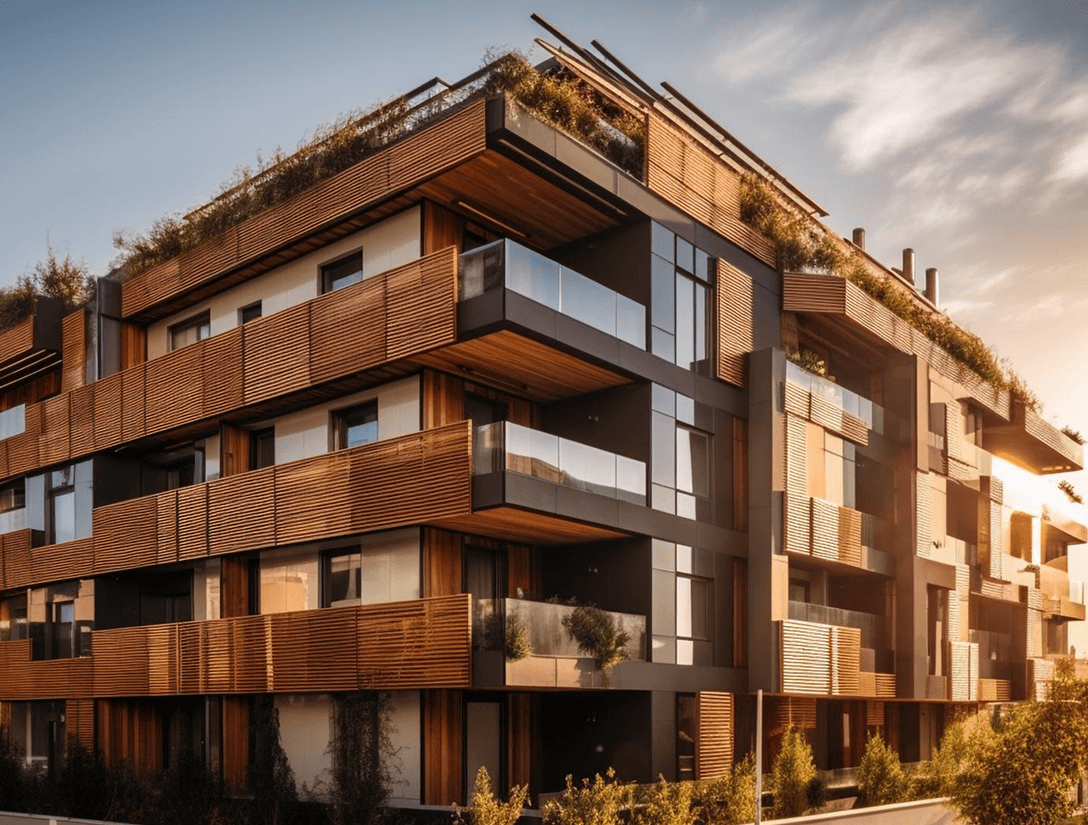
Cross-laminated timber, or CLT, is an engineered wood product made by layering timber panels in alternating perpendicular directions, bonding them with structural adhesives under pressure. The result is a panel that is dimensionally stable, structurally strong, and capable of spanning significant distances — properties that make it suitable for use as floors, walls, and roofs in multi-storey buildings.
The structural performance of CLT has been demonstrated in buildings of increasing ambition across Europe and North America. The 18-storey Brock Commons student residence at the University of British Columbia, completed in 2017, used a hybrid timber-concrete-steel structure that demonstrated mass timber's viability at heights previously reserved for steel frames. More recently, proposals for timber towers of 30, 40, and even 80 storeys have been developed, with several under construction in Scandinavia and Australia.
Beyond its structural properties, CLT offers significant advantages in terms of construction speed and site disruption. Because panels are precision-cut off-site and assembled on-site with minimal wet trades, construction programmes can be significantly shorter than equivalent concrete structures. For developers in urban environments where site disruption is costly, this is a genuine practical advantage, not just an environmental one.
“The carbon argument for mass timber is compelling. The forest question that follows it is harder.”
The carbon argument — and why it is both compelling and complicated
Trees sequester carbon as they grow. A living tree is, in carbon terms, a storage vessel: the carbon dioxide it has absorbed from the atmosphere over its lifetime is locked into its wood. When that wood is harvested and turned into a building material rather than burned or left to decompose, that sequestered carbon remains stored — in theory, for the life of the building.
This is the heart of the mass timber carbon argument: building in wood stores carbon rather than emitting it, making the building itself a kind of carbon sink. Life cycle analyses of mass timber buildings have consistently found them to have significantly lower embodied carbon than equivalent steel or concrete structures, with some analyses showing net negative carbon footprints when sustainable forestry is taken into account.
The complication is the word 'sustainable.' The carbon benefit of mass timber depends entirely on what happens to the forests from which the timber is harvested. If a tree is cut down to make CLT panels and another tree is planted in its place — and that tree grows to maturity in a managed forest that continues to sequester carbon — the logic holds. If the forest is clearcut, or if the replacement tree takes 50 years to reach the carbon storage capacity of the harvested one, the accounting looks very different. The carbon stored in a building today may represent a carbon debt in the forest that will not be repaid for decades.
The forest question that the industry keeps deferring
The mass timber industry's response to this challenge has been the certification system: third-party schemes like FSC (Forest Stewardship Council) and PEFC (Programme for the Endorsement of Forest Certification) that verify sustainable forestry practices. These certifications are meaningful — they represent a genuine commitment to managed forest ecosystems — but they have limits.
First, certification schemes cover a relatively small proportion of the world's productive forest. The majority of timber in global supply chains, even for construction, comes from uncertified sources. As demand for mass timber grows — and it is growing rapidly — there is a real risk that supply chains will be stretched beyond the certified tier into less scrupulous sourcing.
Second, even certified sustainable forestry involves real ecological trade-offs. Monoculture plantations, which make up a significant portion of certified supply, do not replicate the biodiversity of natural forests. The loss of old-growth forest to meet demand for certified replacement timber is an exchange that ecologists increasingly question. The 'sustainable' label, while better than the alternative, does not resolve the underlying tension between forest ecosystems and industrial demand.
Third, the carbon timing problem remains. A plantation tree planted today will not reach the carbon storage capacity of the tree harvested for today's building for 40 to 80 years. In the context of the 1.5-degree carbon budget, which may be exhausted within the next decade, this timing gap matters enormously.
Mass timber in the African and Nigerian context
For sustainable construction in Nigeria and across West Africa, the mass timber question has a particular complexity. Nigeria was once one of the most heavily forested countries in Africa. Decades of commercial logging, agricultural expansion, and fuel wood extraction have reduced the country's forest cover dramatically. According to the Food and Agriculture Organization, Nigeria's total forest area decreased by roughly 50 percent between 1990 and 2015.
In this context, the mass timber proposition — build in wood, store carbon — requires careful qualification. A Nigerian building constructed from sustainably sourced timber imported from Scandinavia may still have a lower embodied carbon than an equivalent concrete building, but the supply chain implications, the transport emissions, and the disconnection from local forestry ecosystems complicate the sustainability narrative considerably.
Local timber species — Nigerian hardwoods, plantation timber from communities in Ondo, Ogun, and Cross River states — could in principle supply a domestic mass timber industry. The potential for community forestry to provide both sustainable building materials and a livelihood for forest communities is real. But the certification infrastructure, the processing technology, and the supply chain coordination needed to make this a reliable source for construction projects at scale are not yet in place.
“Sustainable architecture in Nigeria cannot be imported wholesale from Scandinavia. It must be built from the materials, skills, and ecological realities of the Nigerian context.”
What this means for sustainable architecture in Nigeria
The honest answer, for architects and developers working in Nigeria today, is that mass timber is not yet a straightforwardly available option. The material is not impossible to source, but the supply chains are not mature, the fabrication capacity is limited, and the engineering expertise needed to design and build CLT structures is not widely available. These are solvable problems — but they require investment, policy support, and time.
In the near term, the most impactful decisions for sustainable construction in Nigeria are lower-tech and more immediate: designing for natural ventilation rather than mechanical cooling, specifying locally produced materials that do not require long supply chains, designing buildings that will last rather than those that will be replaced in a decade, and approaching the construction process with attention to material waste.
The mass timber opportunity in Nigeria is real, but realizing it requires a different approach than importing European CLT and calling it sustainable. It requires building a domestic industry: supporting community forestry, developing local processing capability, creating the regulatory framework that would allow engineered timber structures to be certified and insured. That work is slower and less glamorous than designing a beautiful timber building. But it is the work that would make sustainable architecture in Nigeria genuinely sustainable, rather than a well-intentioned import.
For firms like X35 Projects, committed to design that is honest about its context, this means engaging with the material realities of the Nigerian construction industry as they are, while advocating for the systemic changes that would make better options available. Sustainability in architecture is not a finish — it is a direction of travel. The forest question does not have a clean answer. It has a direction: harvest less, plan better, build to last.
More Articles
FEBRUARY 4, 2026
Nigerian Architecture's Identity: Between Borrowed Forms and Genuine Expression
From colonial-era buildings to Lagos's glass towers, Nigerian architecture has always been negotiating between imported ideas and indigenous forms. The next chapter may finally be written from within.
MARCH 4, 2026
The 15-Minute City Revisited: Lessons for Lagos
Paris proved the 15-minute city concept could reshape urban life. Now cities from Bogotá to Nairobi are trying — with mixed results. What Lagos can learn from a decade of experiments in proximity-based urban planning.
FEBRUARY 18, 2026
Mass Timber and the Forest Question: Sustainable Construction in Nigeria
Cross-laminated timber promises a greener future for construction — but harvesting at scale demands uncomfortable conversations about forests, carbon, and whether sustainable architecture in Nigeria is truly possible.
